


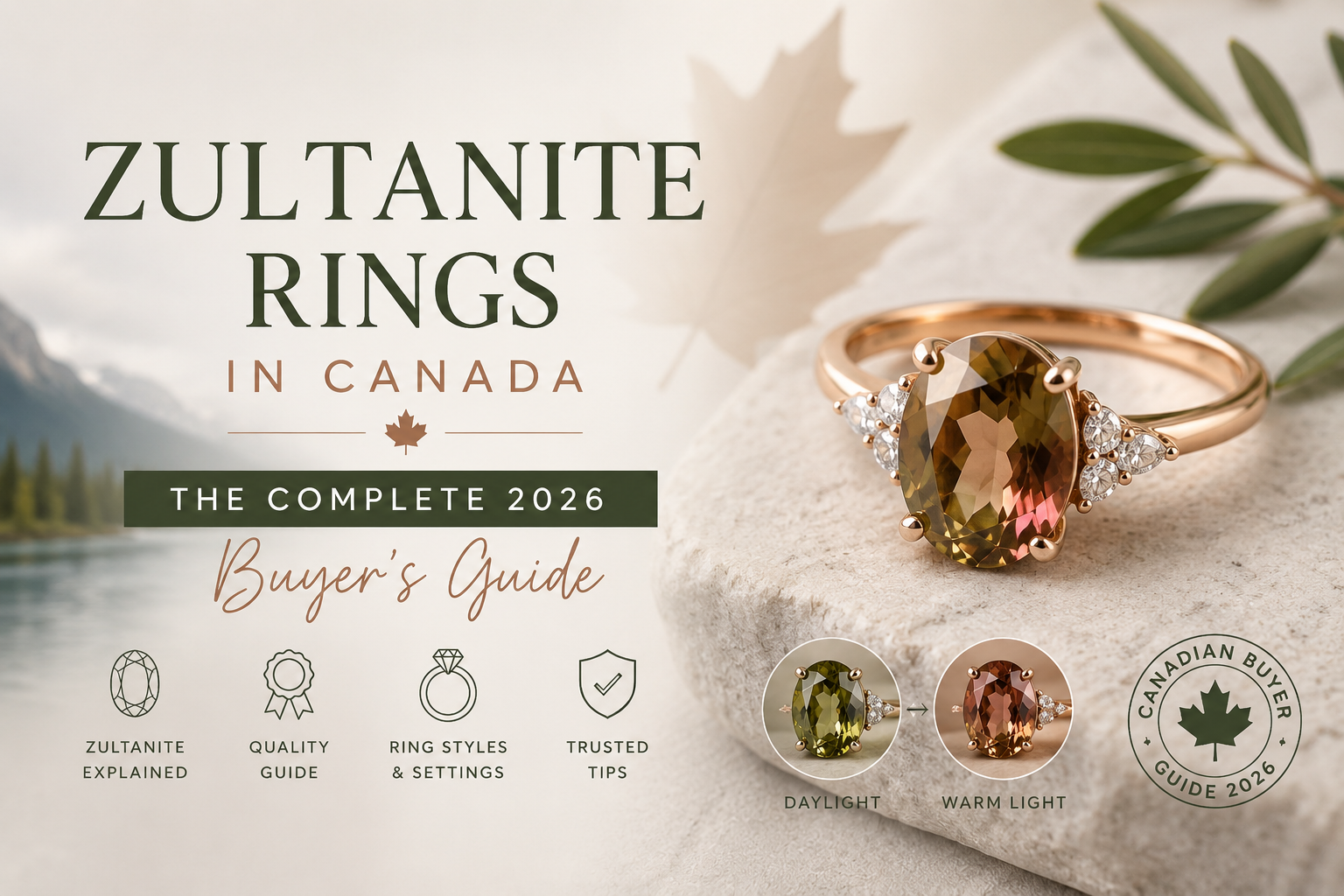
Zultanite Rings in Canada: The Complete 2026 Buyer’s Guide
If you’ve ever watched a gemstone turn from cool kiwi-green in the afternoon sun to a warm raspberry-champagne under your kitchen lights, you’ve seen why zultanite quietly developed a cult following. It’s one of the few stones on Earth that genuinely changes colour and unlike its famous cousin alexandrite, it won’t quietly empty your bank account.
This guide is written for Canadian shoppers. We’ll cover what zultanite actually is, why people fall for it, how much a ring realistically costs in Canadian dollars, how to tell a genuine stone from a lab-grown one or an outright fake, where you can actually buy one in Canada, and how to keep it looking its best. By the end you’ll know exactly what you’re looking at and what questions to ask before you spend a dollar.
A quick note up front, because it saves disappointment: if you came here searching for a list of “zultanite ring manufacturers in Canada,” the honest answer is that no such manufacturing industry exists and that’s not a problem, it just changes how you shop. We’ll explain why further down, and show you the real options Canadians use.
What is zultanite, really?
Zultanite is a trade name for gem-quality, colour-change diaspore an aluminium oxide hydroxide mineral. In plain terms: diaspore is the species, and “zultanite” is the brand applied to the rare, transparent, colour-shifting version of it that comes out of one specific corner of the world.
That corner is Turkey. Gem-grade colour-change diaspore is mined almost exclusively in the İlbir (Anatolian) Mountains of southwest Turkey, at an elevation of more than 4,000 feet. It is genuinely a single-source gemstone, which is a big part of why it carries the rarity and the price tag that it does. Plenty of localities around the world contain diaspore, but transparent, faceting-grade, colour-change material is essentially unique to this one Turkish deposit.
The name itself is relatively young. The stone was rebranded in the mid-2000s “diaspore” was thought to sound unappealing for fine jewellery and commercial gemstone mining of the deposit began around 2006. Two trade names dominate the market today: Zultanite® and Csarite®. Both are trademarks, and this matters for buyers (more on that shortly). You’ll also occasionally see the untrademarked nicknames Turkizite and Ottomanite, and of course the plain mineral name, diaspore, used by sellers who don’t have the licence to use the trademarked terms.
Why the colour changes?
Zultanite’s party trick is called pleochroism combined with a true colour-change effect the stone shows different colours depending on both the viewing angle and, crucially, the type of light hitting it. The shift is driven by trace elements (manganese, with chromium and iron) in the crystal lattice, which absorb different wavelengths under different light sources.
In practice, here’s roughly what you’ll see:
- Daylight / outdoors: soft kiwi or sage green, often with yellow flashes.
- Incandescent / warm indoor light: champagne, pink, raspberry, sometimes cognac-orange tones.
- Candlelight: the warmest end purplish-pinks and soft reds.
It never goes to harsh, fully saturated colours; the hues stay soft and earthy, which is exactly why it pairs so well with both white and yellow metals. And the effect tends to be more pronounced in larger stones, which is why bigger zultanite gems command a premium beyond what their carat weight alone would suggest.
The hardness question (read this before you wear it daily)
Zultanite sits at 6.5 to 7 on the Mohs hardness scale comparable to tanzanite, and respectable for jewellery. But there’s a catch that every buyer should understand: diaspore has perfect cleavage, the same structural trait diamonds have. That means a sharp knock at the wrong angle can cause it to split cleanly rather than simply chip.
This doesn’t make zultanite unsuitable for rings far from it but it does mean a protective setting and a bit of care go a long way. It’s why you’ll see zultanite most often in bezel settings and well-built prong designs rather than exposed, high-set mounts. We cover care in detail near the end.
Why choose a zultanite ring?
Three things drive the appeal, and they tend to land differently for different buyers.
1. The colour change is genuinely magical and rarer than you think
Most gemstones look the same all day. Zultanite gives you, in effect, several stones in one: a green ring at brunch and a pinkish-champagne ring at dinner. For people who find a single static colour boring, that’s the whole pitch right there.
2. It’s the affordable alternative to alexandrite
Alexandrite is the gold standard of colour-change gems and is priced accordingly it’s one of the most expensive coloured stones in the world. Zultanite delivers a comparable “wow” at a fraction of the cost, typically somewhere in the range of 5 to 20 percent of what equivalent alexandrite would run. And arguably it gives you more to look at: where alexandrite shifts between two main hues, zultanite can move through several. For a colour-change ring that won’t require a second mortgage, it’s the obvious pick.
3. Real rarity and a single-source story
In an era where “rare” is a marketing word, zultanite is the genuine article one mine, one country, modest annual production. The yield of gem-quality material from the rough is famously low. For collectors and for buyers who want a piece with a real provenance story rather than a mass-produced stone, that scarcity is the draw.
The trade-off, in fairness, is durability relative to a sapphire or diamond, and the fact that the supply chain runs through a single foreign source. Neither is a dealbreaker they’re just things to factor in, especially if you’re considering zultanite for an engagement ring you’ll wear every single day.
“Are there zultanite ring manufacturers in Canada?” the honest answer
Let’s tackle this directly, because it’s one of the most-searched and most-misunderstood questions on the topic.
There is no domestic zultanite manufacturing industry in Canada, and there can’t be the raw gemstone exists in only one place on Earth, and that place is Turkey. Any article promising you a ranked list of “50 zultanite ring manufacturers in Canada” is almost certainly padding a list with retailers, drop-shippers, marketplace sellers, or simply invented names. That’s worth knowing before you trust a “top 50” page anywhere.
What does exist for Canadian buyers is more useful than a fake list four real, practical routes to a zultanite ring:
1. Canadian retailers and custom jewellers
A handful of Canadian jewellery businesses source zultanite (or colour-change diaspore) and either stock finished rings or build custom pieces. As one example, Smyrna Wonders in Ottawa stocks zultanite rings and ships across Canada. More broadly, many independent Canadian goldsmiths will happily set a zultanite stone into a custom design for you they’re not “zultanite manufacturers,” but they are the people who can put a Canadian-made setting around a Turkish stone. If buying domestically and supporting a local jeweller matters to you, this is your route. Ask whether they can source the stone or whether you supply it.
2. Canadian gem cutters
Canada actually punches above its weight in fine gem cutting. The Wobito brothers of Ontario, for instance, are internationally recognised lapidaries who have cut significant zultanite stones. This matters because cutting is the single hardest part of working with this gem its perfect cleavage means an inexpert cut can shatter the rough, so a skilled cutter is worth seeking out if you’re buying a loose stone to have set.
3. Canadian-facing marketplaces
Etsy Canada and Amazon.ca both carry a wide range of zultanite rings silver, gold-vermeil, and solid gold, in natural and lab-created versions. The sellers themselves are frequently based in Turkey (the source) but ship to Canada, often with CAD pricing and Canadian shipping options shown at checkout. This is the highest-volume, lowest-friction route, and it’s where most casual buyers actually purchase. The trade-off is that quality and authenticity vary enormously seller to seller, so the buyer-protection checklist further down matters most here.
4. International specialist brands that ship to Canada
Several established colour-change-gem brands ship internationally and serve Canadian customers names like Giliarto, Norm Jewels, Provenance Gems and Verna Artisan Works appear repeatedly in this space. Some sell natural zultanite; several specialise in lab-created zultanite set in solid gold. These tend to offer more design polish and clearer authenticity documentation than a random marketplace listing, at a corresponding price.
So the practical takeaway: don’t shop for a “Canadian manufacturer.” Shop for a trustworthy seller Canadian or international and a stone whose authenticity you can verify. That’s the framework the rest of this guide is built around.
How much does a zultanite ring cost in Canada?
Price depends on four things: whether the stone is natural or lab-created, the carat size and colour-change strength, the metal (sterling silver vs. solid gold), and any accent stones (diamonds, moissanite). Because the stone is single-source and the market is small, prices vary more than for mainstream gems treat the ranges below as realistic starting points in Canadian dollars, not fixed quotes, and always confirm with the seller.
| Type of ring | Typical price range (CAD) | What you’re getting |
| Lab-created zultanite, sterling silver | ~$40 – $150 | Entry-level; great for trying the colour-change look |
| Lab-created zultanite, gold-vermeil / 10–14k gold | ~$300 – $1,200+ | Better metal, durable, the sweet spot for many buyers |
| Natural zultanite, small stone, sterling silver | ~$150 – $600 | A genuine single-source stone at an accessible price |
| Natural zultanite, larger eye-clean stone, gold + diamonds | ~$1,500 – $10,000+ | Fine-jewellery territory; price climbs steeply with size |
| Collector / exceptional large natural stones | $10,000+ | Rare, eye-clean, strong colour change; investment-grade |
A few things worth understanding about that table:
- Lab-created vs natural is the biggest price lever. Lab-grown zultanite is visually very similar to natural and costs a small fraction of the price. It’s a completely legitimate choice just make sure you’re told which one you’re buying (see the next section).
- Size matters more than usual. Because the colour-change effect strengthens in larger stones, and because gem-quality rough is scarce, the price-per-carat of natural zultanite rises sharply as the stone gets bigger and cleaner. A 1-carat natural stone and a 5-carat natural stone are not a 5× price difference the larger one carries a premium.
- Watch suspiciously low prices. A “natural zultanite” ring priced like costume jewellery is a red flag it’s far more likely to be lab-created (fine, but it should say so) or a glass imitation (not fine). Genuinely cheap “natural” zultanite usually isn’t.
- Factor in Canadian realities. If you’re ordering from a Turkish marketplace seller or a US/UK brand, budget for currency conversion, potential duties or taxes on import, and shipping. Check whether the listed price is in CAD or another currency before you celebrate a bargain.
Natural vs. lab-grown vs. imitation: how to tell what you’re buying
This is the single most important section for protecting yourself, so it’s worth slowing down. There are three distinct things being sold under the “zultanite” umbrella, and they are not interchangeable.
Natural zultanite
Mined colour-change diaspore from Turkey. The real, rare article. Genuine trademarked Zultanite® typically comes with a Zultanite® Authenticity Guarantee a card with an embedded hologram that confirms the stone is natural, untreated, and ethically mined, along with its origin and care details. If you’re paying natural-stone prices, you should expect documentation. No paperwork on a “natural” stone at a premium price is a reason to pause.
Lab-created (lab-grown) zultanite
Diaspore grown in a laboratory, usually by a hydrothermal process. It’s chemically and optically very close to natural and shows the same colour change. There is nothing wrong with lab-created zultanite it’s more affordable, more sustainable in its footprint, and increasingly popular, especially in solid-gold designs from specialist brands. The only rule is transparency: a reputable seller will clearly label it “lab-created” or “lab-grown.” A seller who is vague about it, or who lets you assume it’s natural, is the problem not the stone.
Glass imitation (the one to avoid)
This is the trap. Manufacturers can make colour-change glass often using elements like neodymium and praseodymium that mimics a colour shift and gets sold as “zultanite.” Tellingly, glass imitations usually shift from yellow-green under fluorescent light to a brownish-yellow under incandescent, rather than the rich champagne-to-raspberry of the real thing. There are also feathery, off-white, metallic-looking fakes circulating on auction sites. These are not zultanite; they’re costume material wearing the name.
How to protect yourself
- Ask the direct question: “Is this stone natural, lab-created, or simulated/glass?” A trustworthy seller answers plainly and in writing.
- Demand certification for natural stones. For genuine trademarked material, look for the Zultanite® (or Csarite®) authenticity documentation. For any significant natural purchase, an independent gemological certificate is the gold standard it’s the only truly reliable proof of natural origin.
- Mind the trademark. Because “Zultanite” and “Csarite” are legally protected names, sellers using them should be licensed affiliates. A seller using the plain term “colour-change diaspore” isn’t necessarily selling something inferior they may simply lack the licence but a seller slapping “Zultanite®” on glass is misrepresenting the product.
- Test the colour shift yourself if you can. Genuine zultanite moves between green-ish daylight tones and warm pink/champagne indoor tones. Step into sunlight, then under a warm bulb. A weak, muddy, or yellow-to-brown shift is a warning sign.
- Be wary of bargains. As above a too-good-to-be-true natural stone almost always is.
Choosing the right setting and metal
Because of zultanite’s perfect cleavage, the setting isn’t just an aesthetic decision it’s a protective one.
Bezel settings wrap metal fully around the stone’s edge and are the safest choice for a ring you’ll wear often. They shield the most vulnerable points from knocks. Halo settings surround the centre stone with a ring of small accent stones (often diamonds or moissanite), which both protects the girdle and amplifies sparkle a popular and practical option. Sturdy prong settings can absolutely work and show off more of the stone, but favour well-built, slightly lower-profile prongs over delicate high-set ones.
On metal: zultanite’s soft, shifting palette is unusually flexible. Yellow and rose gold lean into the warm pink-champagne side of the colour change and give a vintage, romantic feel. White gold and platinum keep things cool and modern and let the green daylight tones read more clearly. Sterling silver is the budget-friendly route and looks excellent, with the caveat that silver is softer and tarnishes, so it suits occasional-wear pieces better than daily drivers. Solid gold is the better long-term investment for a ring you intend to keep.
For accent stones, zultanite pairs beautifully with white diamonds, pink sapphires, and green stones anything that echoes one of the colours already inside it.
Is zultanite a good engagement ring stone?
It can be a wonderful, distinctive choice with eyes open.
The case for it: it’s unique, deeply meaningful (a stone that changes with the light is an easy metaphor for a relationship that adapts and endures), and it gives you genuine rarity and a colour-change effect at a price that leaves room in the budget. As an alternative to a predictable diamond solitaire or as a far more affordable route to a colour-change ring than alexandrite it’s compelling.
The honest caveat: at 6.5–7 Mohs with perfect cleavage, zultanite is not as bombproof as a sapphire (9) or diamond (10). For an engagement ring that never comes off and takes daily abuse gym, dishes, gardening that’s a real consideration. The mitigations are straightforward: choose a protective bezel or halo setting, consider solid gold over silver, and be willing to take the ring off for rough activities. Many people happily wear zultanite engagement rings; they just treat them as the special-occasion-and-careful-daily-wear pieces they are, not as indestructible. If your partner is hard on jewellery and that worries you, a zultanite right-hand ring or anniversary piece may be the happier long-term call.
How to care for your zultanite ring?
Treat it well and it will reward you for decades. The two facts driving all of this care advice are its moderate hardness (6.5–7) and its perfect cleavage.
- Clean it gently. Warm water, a drop of mild dish soap, and a soft brush. Wipe dry with a soft cloth. That’s it.
- Skip the ultrasonic and steam cleaners. The vibration and heat can exploit that cleavage. Hand-cleaning is safest.
- Keep chemicals away. Take the ring off before swimming (chlorine), cleaning with household products, or applying perfume, hairspray, and lotions. Chemicals dull both the stone and the metal over time.
- Remove it for rough work. Gym sessions, gardening, moving furniture, sports anything with a real risk of a sharp impact. One unlucky knock is what cleavage punishes.
- Store it separately. Keep it in its own soft pouch or a lined compartment so harder stones (and the ring’s own setting) can’t scratch it, and so it can’t scratch anything else.
- Get prongs checked periodically. If your stone is prong-set and worn often, have a jeweller check the setting once a year so a loosening prong never becomes a lost stone.
Quick buyer’s checklist
Before you click “buy” or hand over your card, run through this:
- Natural, lab-created, or glass? Get the answer in writing.
- Documentation? Authenticity card / hologram for trademarked material; an independent gem certificate for any serious natural purchase.
- Does the price make sense? Suspiciously cheap “natural” zultanite is a red flag.
- Right setting? Bezel or halo for daily wear; sturdy prongs at minimum.
- Right metal for your life? Solid gold for daily/keepsake; silver for occasional wear and tighter budgets.
- Colour-change quality? Ask for (or check) the shift between daylight green tones and warm indoor pink/champagne tones.
- Canadian logistics? Confirm CAD pricing, shipping to Canada, return policy, and any duties/taxes if importing.
- Seller reputation? Reviews, clear contact details, a real return/exchange policy.
Frequently asked questions
Is zultanite a real gemstone?
Yes. Zultanite is a real, naturally occurring gemstone it’s the trade name for gem-quality colour-change diaspore mined in Turkey. (Note that lab-created and glass-imitation versions also exist, so confirm which you’re buying.)
Is zultanite rare?
Very. Gem-quality colour-change diaspore comes from a single deposit in the İlbir/Anatolian Mountains of southwest Turkey, and only a small fraction of the mined rough is good enough to facet. That single-source rarity is central to its appeal.
Can you actually buy zultanite rings in Canada?
Absolutely just not from a domestic “manufacturer,” because the stone is mined only in Turkey. Canadians buy through local retailers and custom jewellers, Canadian-facing marketplaces like Etsy Canada and Amazon.ca, and international specialist brands that ship to Canada.
How much is a zultanite ring in Canada?
Roughly CA$40–$150 for lab-created stones in silver, a few hundred dollars for natural stones in silver or lab-created in gold, and anywhere from ~$1,500 into five figures for larger, eye-clean natural stones in gold with diamond accents. Size and natural-vs-lab status are the biggest price drivers.
What’s the difference between zultanite, diaspore and csarite?
Diaspore is the mineral species. Zultanite® and Csarite® are both trademarked trade names for the high-quality, colour-change Turkish version of diaspore. All zultanite is diaspore, but only Turkish, trademark-licensed material can legally be called zultanite or csarite.
Is zultanite the same as alexandrite?
No, but they’re often compared because both change colour. Alexandrite is harder, more famous, and far more expensive; zultanite is a more affordable colour-change alternative that often shows a wider range of hues. Think of zultanite as the accessible entry into colour-change jewellery.
How do I know if my zultanite is real?
Look for authenticity documentation (a Zultanite®/Csarite® hologram card for trademarked material) or, for natural stones, an independent gemological certificate the only fully reliable proof. As a quick field check, genuine zultanite shifts from green-ish daylight tones to warm pink/champagne indoor tones; a yellow-to-brown shift or a feathery, off-white appearance points to glass.
Is zultanite good for an engagement ring?
It can be a beautiful, meaningful choice, but it’s softer and more cleavage-prone than diamond or sapphire. Choose a protective setting, lean toward solid gold, and be willing to remove it for rough activities. For someone very hard on jewellery, an anniversary or right-hand ring may suit better.
Why can’t I find zultanite ring manufacturers in Canada?
Because the raw gemstone only comes from Turkey, there’s no domestic zultanite mining or large-scale manufacturing base in Canada. The realistic Canadian options are local retailers and custom jewellers who set the stone, skilled Canadian gem cutters, and reputable online sellers who ship to Canada.
The bottom line
A zultanite ring is one of the most distinctive things you can put on your hand for the money a genuinely rare, single-source gem that changes colour with the light, at a fraction of alexandrite’s cost. The keys to buying well in Canada are simple: know whether you’re buying natural or lab-created, insist on authenticity documentation, choose a protective setting, and buy from a seller you can trust rather than chasing a mythical “Canadian manufacturer.” Get those right and you’ll have a ring that draws a “wait did that just change colour?” every single time the light shifts.